
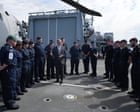
Richard Barrons has said Pete Hegseth was right to mock the Royal Navy, adding his support to warnings that the UK’s armed forces are not adequately equipped for the current global security environment.
The former army chief backed George Robertson’s concerns and argued that Britain’s military is “too small and undernourished for the world that we now live in.” His comments reflect growing alarm about the state of defence capabilities as pressure mounts on the government to move faster on military spending.
Barrons’ remarks were made in the context of a wider political row over defence underfunding and the pace of change in the UK’s armed forces. The debate has intensified as the war in Ukraine continues, with Russia’s invasion widely seen by ministers and defence figures as a major warning sign for Europe and for Britain’s own security planning.
In the live political discussion, one question also focused on why there was a call for an inquiry into Nigel Farage’s investment in a bitcoin firm. Responding to that issue, Liberal Democrat leader Ed Davey said Farage, who leads Reform UK, appeared to be copying Donald Trump by investing in crypto.
Davey said he believed MPs should be banned from promoting financial services or products. He argued that Farage was now promoting the business and raised the question of whether he was persuading people to put money into a risky investment.
“And the conclusion I draw from this example is that we need to change the rules for MPs,” Davey said. “MPs should not be allowed to promote specific financial services or products in the way we’re seeing Nigel Farage doing.”
He also used the exchange to stress the seriousness of the defence situation facing the country. “We need to get together as a country,” Davey said. “The defence challenges for our country are so serious, with war on our continent for the first time for a long time, with Russia invading Ukraine, surely that’s been the wake up call that we needed. The government hasn’t gone as fast as it should have given those circumstances.”
The remarks capture two separate but politically significant pressures on the government and opposition alike: concern over how Britain should respond to the security threat posed by Russia, and questions about standards and conduct in public life. Both issues are likely to remain central as parties continue to debate spending, regulation and national preparedness.
For Barrons, the message was clear: Britain’s forces need more than symbolic support. His criticism adds weight to a broader argument among military figures that the country’s armed services are stretched and under-resourced at a time when the strategic environment has become more dangerous.
His intervention also places fresh attention on the long-running question of whether the government has moved quickly enough to adapt defence policy to new realities. With war continuing in Europe and concerns rising over the resilience of British forces, calls for investment and reform are expected to intensify.

