
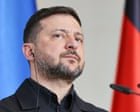
Ukrainian president Volodymyr Zelenskyy has welcomed Péter Magyar’s decisive victory in Hungary, describing it as “the victory of light over darkness” and expressing hope for a more pragmatic relationship with the country’s next government.
The result marks a sharp change from the previous administration, which Zelenskyy and others have characterised as hostile and aligned with Russian interests. He said he expected “friendly” ties with the new leadership, in contrast to what he described as the previous pro-Russian regime.
Speaking in Berlin alongside Zelenskyy, Germany’s chancellor Friedrich Merz also praised Magyar’s win. Merz said the result would have “implications for our support for Ukraine”, underscoring the broader European significance of the political shift in Budapest.
Merz added that more Hungarians than ever before took part in the vote. According to him, voters delivered an overwhelming rejection not just of a government, but of an entire political system. The scale of the result, he suggested, went beyond a routine change of administration and pointed to a deeper public demand for change.
Merz also said he and Zelenskyy had discussed the need for military assistance to reach Ukraine quickly. He said the funds “must now be disbursed quickly” and stressed that Ukraine needs them urgently.
The comments came during a period in which European leaders are watching Hungary closely, given the country’s role in debates over aid to Ukraine, relations with Russia, and the future direction of EU policy. Magyar’s victory is likely to reshape those discussions, particularly if his government takes a more cooperative approach to Kyiv than the Orbán era.
Zelenskyy’s remarks reflected that expectation. By framing the result as a triumph over darkness, he signalled both relief and optimism that relations between Kyiv and Budapest may improve after years of tension.
For Germany, too, the outcome appears to carry practical consequences. Merz’s reference to support for Ukraine suggested that a new government in Hungary could affect not only bilateral ties but also the wider European response to the war.
Hungary has long been one of the more contentious voices in the EU on questions related to Ukraine and Russia. A decisive shift in government, if it leads to a new foreign policy stance, could therefore have an impact well beyond Hungary’s borders.
For now, the immediate reaction from Zelenskyy and Merz was one of cautious optimism. Both men pointed to the result as evidence of change, while also stressing the urgency of turning political shifts into concrete support for Ukraine.

