
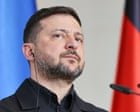
Ukrainian president Volodymyr Zelenskyy has welcomed Péter Magyar’s decisive election victory in Hungary, describing it as “the victory of light over darkness” and saying he hopes for a more pragmatic and friendly relationship with the country’s new government.
The result marks a dramatic political shift in Hungary after what Zelenskyy described as a hostile, pro-Russian regime under Viktor Orbán. His remarks reflected expectations in Kyiv that a change in Budapest could alter Hungary’s stance on Ukraine and on wider European cooperation.
In Berlin, Germany’s chancellor Friedrich Merz also praised Magyar’s win. Speaking at a press conference alongside Zelenskyy, Merz said the outcome would have “implications for our support for Ukraine.” He added that “more Hungarians than ever before cast their votes,” and said that by an overwhelming majority they had voted not only to remove a government but to remove “an entire system.”
Merz also underlined the urgency of financial assistance for Ukraine. “Volodymyr Zelenskyy and I also discussed this. The funds for military support must now be disbursed quickly. Ukraine needs them urgently,” he said.
The comments came as European leaders watched closely for the political consequences of Magyar’s victory. For Kyiv, the change in Hungary matters not only because of bilateral relations but also because of Hungary’s role in EU discussions on Ukraine, military aid, and sanctions against Russia.
Zelenskyy’s language suggested cautious optimism that the new administration in Budapest could adopt a more cooperative approach than the one associated with Orbán. He said he hoped for relations that would be both pragmatic and friendly, signaling a desire for practical engagement rather than the open friction that has often characterized Ukraine’s dealings with Hungary in recent years.
Merz’s remarks indicated that the result could also influence the broader European response to the war. By linking Magyar’s victory to support for Ukraine, the German chancellor suggested that Hungary’s political shift may have significance beyond its borders, especially at a moment when military and financial backing remain central to Ukraine’s defense.
The election outcome was presented by both leaders as more than a routine change in government. For Zelenskyy, it represented a rejection of a political order he views as aligned against Ukraine. For Merz, it was evidence of a major democratic mandate and a potential opening for stronger European coordination.
As Hungary prepares for a new government, the emphasis from Kyiv and Berlin is on what happens next: whether the new leadership will move quickly, whether support for Ukraine will be affected, and whether the tense relationship between Budapest and Kyiv can be reset on more constructive terms.

