
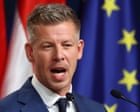
Hungary’s election winner Péter Magyar is preparing for a rare appearance on the country’s state media, after spending 18 months without a broadcast interview there before the election. Magyar has accused Hungary’s state broadcasters of spreading propaganda for Viktor Orbán, and has signalled that he intends to overhaul them.
The appearance marks a notable moment in the run-up to a political reset in Hungary, where Magyar has emerged as a major challenger to the existing system. According to the source report, he had not appeared on state media for 18 months before the election.
Pressure on the broadcasters
Magyar’s criticism of the state media has been central to his campaign against Orbán’s political machine. His expected return to the airwaves comes as he prepares to take a more active role in reshaping how the broadcasters operate.
The source item describes his victory as decisive and says he has framed it not simply as a change of government, but as rejection of a broader political order. In his post-election remarks, he said: “More Hungarians than ever before cast their votes. By an overwhelming majority, they voted not only to oust a government, but to oust an entire system.”
Merz links result to Ukraine support
The Hungarian result also drew attention in Berlin. At a press conference with Ukraine’s president Volodymyr Zelenskyy, Germany’s chancellor Friedrich Merz welcomed Magyar’s victory and said it would have “implications for our support for Ukraine”.
Merz added that he and Zelenskyy had discussed the issue of military aid and the need for the funds to be made available quickly. “The funds for military support must now be disbursed quickly. Ukraine needs them urgently,” he said.
The chancellor’s comments underline the wider European significance of the Hungarian vote, particularly as governments continue to coordinate support for Kyiv. Merz also said: “Volodymyr Zelenskyy and I also discussed this.”
Magyar’s rise and his confrontation with Hungary’s state media place him at the centre of a major political shift. With the election behind him, his next steps are likely to focus not only on governing, but on changing the institutions that helped shape the country’s political debate for years.
The appearance on state media is therefore more than a routine interview. It reflects both Magyar’s changing status and the tensions surrounding the future of Hungary’s public broadcasters, which he has accused of serving Orbán’s agenda rather than the public interest.
As the new political moment takes shape, the Hungarian result is being watched well beyond Budapest. For Germany and other European capitals, it is already being read through the lens of support for Ukraine, media reform, and the broader question of how Hungary’s political system may now evolve.

