
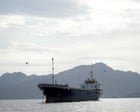
The crisis around the Strait of Hormuz continued to deepen on Tuesday as the US blockade of Iranian ports remained in place after a deadline passed. At the same time, diplomatic efforts were edging forward in Europe and Asia, with reports suggesting that Iran-US talks could resume in Pakistan later this week.
In a separate development, Emmanuel Macron and Keir Starmer are expected to co-host a summit in Paris on Friday, with France and the UK set to chair discussions linked to the situation around the strait. The gathering comes as governments try to manage the military, diplomatic and economic fallout from the confrontation.
South Korean president Lee Jae Myung warned that the escalating tensions around Hormuz make it difficult to be optimistic about the wider consequences of the Iran war. Speaking at a cabinet meeting on Tuesday, he said the government should assume that disruption in global energy and raw materials markets will last for some time.
Lee said high oil prices and supply-chain strains are likely to continue, and urged officials to prepare accordingly. He called for the development of alternative supply chains, medium- to long-term industrial restructuring, and what he described as a transition to a post-plastic economy as national strategic priorities.
His comments reflected growing concern in Asia and beyond that any prolonged disruption in the Strait of Hormuz could ripple through energy prices and manufacturing supply lines. The narrow waterway is a critical route for global trade, and even the prospect of further instability has already heightened market anxiety.
Meanwhile, the conflict is also intersecting with long-running regional tensions elsewhere. Lebanon and Israel have been at war in some form since the early 1980s, and the two countries do not have diplomatic relations. Lebanese law also bars entry to anyone with an Israeli stamp in their passport.
Against that backdrop, direct talks between the two governments have drawn attention as a notable diplomatic development. The fact that such discussions are taking place at all has been described as remarkable, given the long history of hostility and the absence of formal ties.
As the situation develops, attention will remain fixed on whether diplomacy can keep pace with events on the ground and at sea. With the US blockade continuing and regional leaders warning of economic fallout, the coming days are likely to be closely watched by governments, markets and energy consumers alike.
The Paris summit and any possible resumption of Iran-US talks in Pakistan may help clarify whether a broader de-escalation is possible. For now, however, the picture remains one of high tension, persistent uncertainty and growing pressure on global supply chains.

