
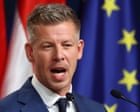
Hungary’s election winner is preparing for a rare appearance on state media after accusing the country’s broadcasters of spreading propaganda in support of Viktor Orbán’s government. The opposition figure had not appeared on state media for 18 months before the election, underscoring the strained relationship between the broadcaster and Orbán’s political opponents.
The planned appearance comes as the new administration signals that it wants to overhaul Hungary’s state broadcasters. The issue has become part of a broader political shift following the opposition win, with questions now turning to how the media landscape may change under the new leadership.
In a separate development, Ukraine’s president Volodymyr Zelenskyy praised the opposition victory in Hungary, describing it as “the victory of light over darkness.” He also called for “pragmatic, friendly” relations with the new Hungarian administration.
Speaking alongside the German chancellor, Friedrich Merz, Zelenskyy said he hoped for “pragmatic” and “friendly” relations with the new Magyar government, marking a sharp contrast with the hostile relationship he associated with the Orbán administration.
The comments reflect a potentially significant shift in Hungary’s regional and European posture after the election result. Zelenskyy’s remarks also suggest expectations that the new government may adopt a more constructive approach toward Ukraine than the previous one.
The state media appearance is notable not only because of the long absence before the election, but also because of the broader tensions it highlights between Hungary’s political opposition and the institutions that have long been seen as aligned with Orbán. The incoming leadership has indicated that reforming those broadcasters will be part of its agenda.
For now, the focus is on whether the new government can translate its election success into institutional change. That includes the role of public broadcasting, which has been at the center of criticism from opposition figures who say it has not provided fair or balanced coverage.
Zelenskyy’s response adds another layer to the evolving political picture. By welcoming the election outcome and pressing for practical cooperation, he appeared to signal cautious optimism about a change in Hungary’s stance, particularly in relation to Ukraine and broader European affairs.
The developments are being closely watched across Europe as leaders assess what the opposition win could mean for Hungary’s domestic media environment and for its foreign policy direction under the new administration.

