
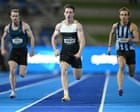
Lachlan Kennedy again went under 10 seconds to win the Australian men’s 100m title at the national championships in Sydney, producing a dominant 9.96sec run to claim his first national crown.
Fireworks boomed over Sydney Olympic Park just before 9pm on Saturday, briefly cutting through the silence as the finalists waited on their blocks for the starting gun. When the race was underway, Kennedy delivered the kind of finish that confirmed his status as one of the country’s leading sprinters, crossing the line 0.2 seconds clear of the field.
The Queenslander’s winning time matched the performance that has marked him as a serious force over 100m, and it also kept him within reach of the Australian record of 9.93sec, which he has now set his sights on.
“I needed the win, I needed to be national champ. I needed to say I had it,” Kennedy said after the race. “It’s a big relief to be able to finally do it in front of an awesome crowd and against great competitors.”
The result added a major title to Kennedy’s season and confirmed his ability to handle the pressure of a national final. With the race staged in front of a strong crowd and a competitive field, the victory carried added significance beyond the time itself.
A final decided in moments
The men’s 100m final came late in the evening, but the race itself was over in a matter of seconds. Kennedy’s start and drive phase put him in control early, and he maintained that advantage to the finish.
His 9.96sec performance meant he broke the 10-second barrier again, reinforcing the consistency that has made him such a prominent name in Australian athletics. Winning by 0.2sec in a sprint final is a clear margin, and it underlined the quality of his run on the night.
For Kennedy, the title was as much about validation as it was about the clock. He made clear that the national championship had been a goal in itself, and that finally securing it was an important step in his career.
Eyes on the national record
Beyond the championship victory, Kennedy’s focus now turns to the national record of 9.93sec. Having run 9.96sec again, he remains close to that mark and has given himself a realistic target for the rest of the season.
The Sydney result will likely strengthen his confidence heading into future races, particularly given the manner of the win and the level of competition he beat to secure it. National titles are often won by fractions, but Kennedy’s performance suggested a sprinter capable of both consistency and speed under pressure.
The race took place against the backdrop of a busy championships programme in Sydney, with fireworks marking the occasion and a strong atmosphere around the stadium. But it was Kennedy’s sprint that provided the defining moment.
His first national title now gives him a new status in Australian sprinting, and the time he posted ensures he remains in range of one of the country’s most significant records. For now, though, the breakthrough he was seeking has arrived: national champion, under 10 seconds, and still chasing faster.

