
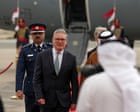
Keir Starmer is concluding his three-day tour of Gulf states with a sharper political message at home, arguing that global instability is helping drive up energy costs for British consumers.
In an article for the Guardian, the prime minister explicitly blamed US president Donald Trump for higher bills in Britain, and also pointed to Vladimir Putin’s actions as part of the wider forces putting pressure on households. Starmer’s intervention comes as he wraps up a visit that has been closely watched for signs of how the UK is trying to navigate a period of uncertainty in the Middle East and beyond.
The prime minister’s trip has not produced any clear plan for resolving the Iran war. Starmer is not one of the central players in the conflict, and his public comments on meetings with Gulf leaders have, so far, been limited. The source material indicates that those remarks have largely amounted to general statements rather than specific proposals.
There is also still no clarity over when, or even whether, the Strait of Hormuz will fully reopen. The eventual outcome, according to the report, will depend on Iran and on the behaviour of a volatile and unpredictable US president.
That uncertainty has become the backdrop to Starmer’s broader message. Rather than offering a detailed diplomatic breakthrough from the Gulf tour, he has used the moment to think aloud about how Britain should react to a world shaped by conflict, disruption and instability.
His comments appear aimed at framing energy prices as part of a wider international crisis rather than a domestic policy issue alone. By linking the pressure on British bills to Trump and Putin, Starmer is placing responsibility for some of the strain on the global stage, not just on the UK government.
The Guardian piece says Starmer has been giving thought to how the country should respond to what he sees as an era of global uncertainty. That argument is now emerging as a central theme of his public messaging as he brings the Gulf trip to a close.
For the government, the challenge is twofold: to show it is engaged in the search for stability abroad, while also convincing voters at home that ministers understand the impact of international turmoil on everyday costs. Energy bills remain one of the most visible ways in which foreign events can be felt inside British households.
Starmer’s remarks suggest he wants to draw that connection clearly. His article for the Guardian sets out some of his thinking on the issue, even as the situation in the region remains unresolved and the prospects for a rapid easing of tensions look uncertain.
The full piece is available in the Guardian, and the wider political debate is likely to continue as the effects of the Iran war and the state of global energy routes continue to be felt.

